Skeet looks simple from the clubhouse: eight stations in a half-circle, two houses, 25 targets. Then someone hands you a scorecard with an odd shape and mentions "the option", and the round stops being obvious. This is how a round of skeet is actually scored — the stations, the two houses, where the doubles fall, and what that 25th bird is for.
The field: two houses, eight stations
A skeet field is a semicircle with a trap house at each end. The high house sits on the left, its window about ten feet off the ground, so its target leaves high and descends across the field. The low house sits on the right with a window near ground level, so its target rises. Both throw to the same crossing point out in front of the field, which is why the two houses feel completely different to shoot even though the targets meet in the middle.
Stations 1 through 7 run around the arc between the houses; station 8 sits in the middle, between them, where the targets arrive fast and close. You walk the stations in order, and the presentation changes at every one — that's the whole point of the sport.
The round: 25 targets
A standard round is 25 targets, and they're distributed like this:
| Station | Targets | Running total |
|---|---|---|
| 1 | High single, low single, doubles (high then low) | 4 |
| 2 | High single, low single, doubles (high then low) | 8 |
| 3 | High single, low single | 10 |
| 4 | High single, low single | 12 |
| 5 | High single, low single | 14 |
| 6 | High single, low single, doubles (low then high) | 18 |
| 7 | High single, low single, doubles (low then high) | 22 |
| 8 | High single, low single | 24 |
| — | The option (the 25th) | 25 |
So: sixteen singles, eight doubles targets, and one option. Every station gives you one high house and one low house. Four of them — 1, 2, 6, and 7 — add a pair.
The option: the 25th bird
The option is the part that confuses everyone, and it's genuinely a little strange. You have 24 scheduled targets and 25 shells. The 25th is held in reserve for your first miss — the instant you miss, you re-shoot that same target immediately, and that's your option gone.
If you get all the way through the first 24 without missing, you never spent it. So at the end you take the option as a second low house at station 8. That's why a 25-straight is genuinely 25 hits: there's no spare bird hiding at the end for people who shot clean.
Practically, this means your score is capped by your first mistake in a way that's unlike trap. Miss target three and your option is spent at station 1 — miss anything later and it simply costs you.
Scoring itself: hit or lost
The scoring is refreshingly blunt. Every target is hit or lost — one point or nothing. A target counts as hit if you knock a visible piece off it; dust that never separates is not a break. There's no partial credit, no points for how far out you broke it, and no difference in value between an easy station-4 high house and a station-8 target that arrives like a thrown brick. 25 targets, 25 possible points.
For doubles, both targets are in the air at once and each is scored on its own. If you break the first and miss the second, that's 1 of 2 — you don't re-shoot the pair.
Why the skeet card looks the way it does
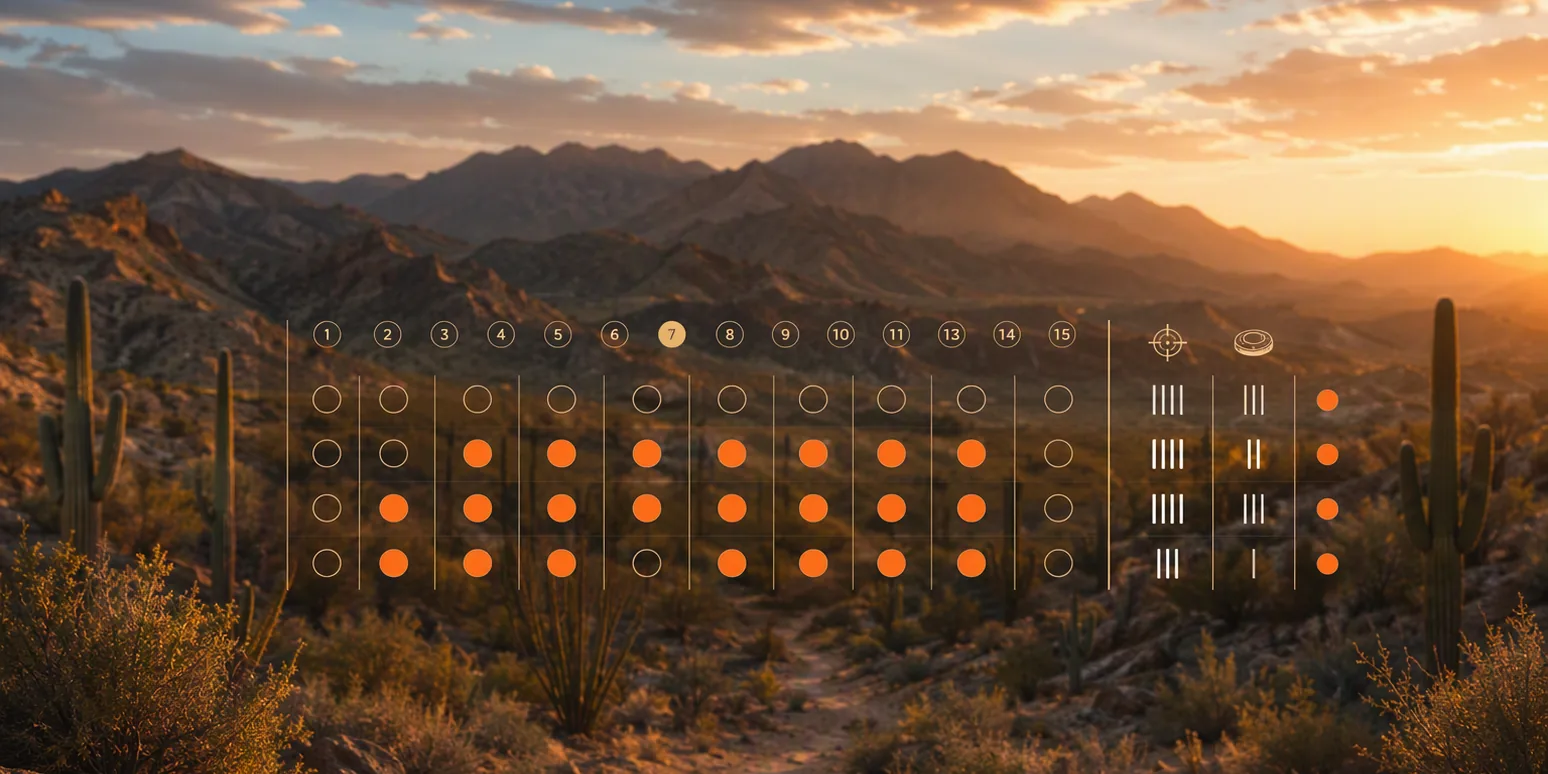
This is why a skeet scorecard is not a row of 25 boxes like a trap card. It has to record which house each target came from, mark the four stations that carry doubles, and leave a spot for the option — otherwise, come the end of the round, nobody can reconstruct where the misses were.
A paper card handles that with a lot of small print and a lot of squinting. ClayTrack's skeet card lays out the real 8-station shape: high and low at every station, doubles marked at 1, 2, 6, and 7, the option at station 8, and a subtotal under each station — so the shape of the round survives, and the arithmetic isn't yours to do.
American skeet vs international
The version above is American skeet (NSSA), which is what you'll shoot at nearly every club in the United States. International (Olympic) skeet shares the same field but is a different sport in practice: a delay of up to three seconds between your call and the target, a low gun position at the ready, faster targets, and a different distribution of doubles. If you're shooting a club round in the US, it's American skeet.
Where skeet sits among the disciplines
Skeet is the most repeatable of the big three: the targets fly the same path every time, so improvement is visible and measurable in a way it isn't on a sporting clays course where the presentations change monthly. That predictability is exactly what makes it worth tracking round over round. If you're deciding what to shoot, see sporting clays vs skeet vs trap, or read the broader guide to clay shooting scorecards. New to clays entirely? Start with what sporting clays is, then find a range near you.

Score your next skeet round on a real 8-station card
ClayTrack is a free skeet scorecard with high and low house, doubles at 1, 2, 6, and 7, and the option — totalled for you, live, with the whole squad. No paper, no download.
Frequently asked questions
How many targets are in a round of skeet?
A standard round of skeet is 25 targets. Sixteen come from high-house and low-house singles at each of the eight stations, eight more from doubles at stations 1, 2, 6, and 7, and the 25th is the option shot.
What is the option shot in skeet?
The option — sometimes called the 25th bird — is the last target of the round. Traditionally you repeat your first missed target the moment you miss it. If you go straight through the first 24, you take the option at the end as a second low house at station 8. It is what makes a 25-straight require 25 hits and no second chances.
Which skeet stations have doubles?
Stations 1, 2, 6, and 7. At stations 1 and 2 the high house target is taken first, then the low house; at stations 6 and 7 the order reverses — low house first, then high. Stations 3, 4, 5, and 8 are singles only.
What is the difference between the high house and the low house?
They are the two trap houses at either end of the skeet semicircle. The high house sits on the left with its window about 10 feet up, so its target crosses on a descending line; the low house sits on the right with a window near ground level, so its target rises. Every station gives you one of each.
Is skeet scored differently from trap?
The scoring itself is the same idea — 25 targets, one point per broken bird, no partial credit. The card differs because the round differs: trap is five stations of five shots straight across, while skeet has eight stations with singles, doubles at four of them, and the option. That is why a proper skeet card is not just a row of 25 boxes.