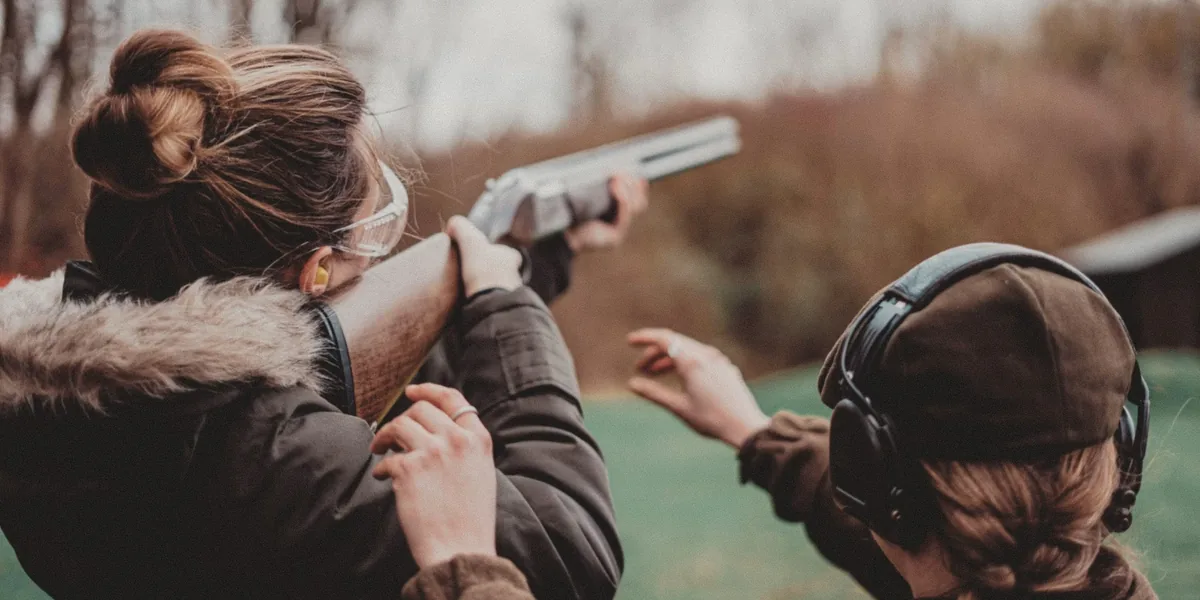
What is Sporting Clays?
Sporting clays is a shotgun shooting sport where participants walk a course and shoot at clay targets launched from a variety of different machines. Unlike skeet or trap — which use fixed, predictable target paths — sporting clays intentionally simulates the unpredictable flight of wild game birds: ducks flushing from a pond, a rabbit bounding through a field, a pheasant rising from cover.
The sport originated in England in the 1920s as a way for hunters to sharpen their wing-shooting skills in the off-season. It arrived in the United States in the 1980s and has grown to over 3 million participants nationwide, governed by the National Sporting Clays Association (NSCA).
What makes sporting clays unique is variety. No two stations on a course are the same, and no two courses at different ranges are the same. Every round presents a fresh challenge — a crossing shot from the left, an overhead target dropping fast, a ground-hugging rabbit skipping across dirt. That variety is what keeps experienced shooters coming back and what makes the sport so rewarding to learn.
Fun Fact
The nickname "golf with a shotgun" comes from the sport's course-based format — like golf, you walk from station to station, and no two courses play exactly alike.
How a Round of Sporting Clays Works
A standard round of sporting clays consists of 100 targets spread across a course of 10 to 15 stations. Each station presents a different shooting challenge — a different target type, speed, angle, and distance.
Here's what a typical round looks like:
- Your group (usually 2–6 shooters) starts at Station 1.
- Each shooter takes a position in the shooting cage — a defined area that controls your angle and position.
- The shooter calls "pull!" (or "ready," depending on the range), the machine launches one or two clay targets, and the shooter attempts to break them.
- Each shooter rotates through all presentations at the station before the group moves on.
- At each station, each shooter typically gets 10 targets (5 pairs). Over the full course, that adds up to 100 targets total.
Most courses are walked outdoors through natural terrain — woods, fields, ponds — which adds to the immersive experience. A full round typically takes 2 to 3 hours depending on group size and pace.
Types of Clay Targets
Sporting clays uses several different clay target shapes, each designed to mimic a specific type of game bird or animal. Understanding each type helps you read the target faster and pick the right shot.
Standard Target
The most common target — a 108mm diameter dome-shaped disc. This is what most people picture when they think of a clay pigeon. It can be presented as an incomer, crosser, or going-away bird at a wide range of speeds and angles.
Midi Target
A smaller version of the standard target at 90mm diameter. Because it's smaller, it appears to move faster than it actually is, which fools many shooters into rushing their shot. Midi targets are great for simulating smaller birds like teal.
Mini Target
The smallest standard target at 60mm diameter — about the size of a hockey puck. Minis are notoriously difficult because they're small, fast-appearing, and often presented on deceptive trajectories. They simulate small birds or insects.
Battue Target
A thin, flat disc that flies on edge before rolling flat and dropping sharply. The battue is tricky because it looks steady at first, then suddenly falls. It simulates a duck cupping its wings to land. Timing is everything.
Rabbit Target
A thicker, reinforced disc designed to roll along the ground rather than fly through the air. The rabbit target simulates a flushing rabbit or pheasant running along the ground. It bounces unpredictably, which makes leading it correctly a real skill.
Rocket Target
A long, narrow target shaped like a cylinder. Rockets fly fast and straight, presenting a very small silhouette. They simulate a driven bird coming straight toward you at speed.
Beginner Tip
Focus on standard targets first. Most beginner-friendly stations use standard clays at moderate speed and distance. Master reading the target's line before worrying about specialty presentations.
Pair Presentations Explained
At most stations, targets are presented in pairs — two clays launched in sequence or simultaneously. The way those two targets are presented defines the pair type, and each requires a different shooting strategy.
| Pair Type |
How It Works |
Strategy |
| True Pair |
Both targets launched simultaneously |
Pick one target first, commit, then swing to the second |
| Report Pair |
Second target launches at the sound of your shot |
Don't watch your first target fall — reload and find the second immediately |
| Following Pair |
Second target launches after the first, on the same line |
Stay on the line — the second target follows the same path |
| Springing Teal |
Target launches straight up and falls back down |
Shoot it going up before it stalls — much easier than catching it on the way down |
How Scoring Works in Sporting Clays
Sporting clays scoring is simple: you either break the target or you don't. One point for a hit, zero for a miss. There is no partial credit, no style points. (For how scorecards work across trap, skeet, and sporting clays, see our clay shooting scorecard guide.)
Over a standard 100-target round, your final score is the total number of targets you broke — the full sporting clays scoring rules (presentations, pairs, what counts as a hit) are on the scoring page. Score ranges roughly break down like this:
- 85–100: Expert / competitive level
- 70–84: Experienced recreational shooter
- 55–69: Intermediate — improving rapidly
- 40–54: Beginner — totally normal for your first several rounds
- Under 40: Still learning — every shooter has been here
Don't be discouraged by a low score early on. Sporting clays has a steep learning curve, and even experienced shooters rarely go perfect. A round of 75/100 is a genuinely good score for a recreational shooter.
Score your first round
Two free ways to keep score on day one: print the
sporting clays score sheet and take it on a clipboard, or
score it on your phone with ClayTrack, which logs every pair at every station and totals the round for you. Either way, keep the card: the trend across your first ten rounds tells you more than any single score.
What Equipment Do You Need?
One of the best things about sporting clays is that you don't need much to get started. Here's what you need:
Shotgun
The most common choice for sporting clays is an over-under (O/U) shotgun in 12 gauge. An O/U gives you two shots without reloading, and the stacked barrels offer a consistent sighting plane. Semi-automatic shotguns are also widely used and can reduce felt recoil.
For beginners, a used 12-gauge over-under in the $500–$1,000 range is a perfectly capable starting point. You don't need an expensive gun to have fun and improve. For a full breakdown of options by price — and semi-auto vs over-under — see our guide to the best sporting clays shotgun for beginners.
Ammunition
Standard sporting clays loads are 7.5 or 8 shot in either 1 oz or 1 1/8 oz loads. Lighter loads (7/8 oz) reduce recoil and are popular for high-volume shooting. Most ranges sell ammunition on site, so don't worry about bringing a case your first time.
Eye & Ear Protection
Non-negotiable. You need shooting glasses (impact-rated, not regular sunglasses) and ear protection. Many experienced shooters use electronic ear protection that lets you hear conversation while blocking the sound of shots.
Optional Gear
- Shell pouch or vest — keeps shells accessible as you walk the course
- Gloves — useful in cold weather or for sensitive hands
- Gun case — required for transporting your shotgun safely
- Scorecard app — more on that below
First Time?
Most ranges offer rental shotguns, loaner ear protection, and on-site instruction. Call ahead and ask about a beginner package — you can try the sport without investing in gear first.
Sporting Clays vs Skeet vs Trap: What's the Difference?
All three sports use clay targets and shotguns, but they feel very different on the course. Here's a quick comparison:
| Sport |
Setup |
Target Path |
Best For |
| Sporting Clays |
Walk a multi-station course outdoors |
Highly variable — different every station |
Hunters, variety seekers, all levels |
| Skeet |
7 fixed stations in a semicircle |
Predictable crossing shots |
Beginners, consistent practice |
| Trap |
5 fixed stations behind a single machine |
Outgoing birds, angles vary slightly |
Beginners, Olympic-style competition |
The key distinction: sporting clays is the least predictable of the three. That's what makes it the most challenging and, for many shooters, the most rewarding. If you're a hunter, sporting clays is the closest you'll get to real-world shooting practice in the off-season.
How to Get Started in Sporting Clays
Ready to try it? Here's a step-by-step path for a first-time shooter:
- Find a local range. Use the NSCA's range locator at nsca.com to find a certified sporting clays course near you. Most metropolitan areas have several options within 30–60 minutes.
- Call ahead. Ask about beginner packages, rental guns, and whether instruction is available. Many ranges offer walk-on rounds — no reservation required.
- Bring a friend. Sporting clays is a social sport. Going with someone who has shot before makes the first round much easier, and it's more fun.
- Take a lesson. Even a single 30-minute lesson with a range instructor will save you from building bad habits early. The fundamentals — mount, swing, lead — are learnable quickly.
- Start at a beginner-friendly range or station. Ask the range staff which stations are easiest. Many courses mark beginner stations or offer a shorter "try it" format with fewer targets.
- Track your scores from day one. Keeping a record of your scores — even rough ones — shows you how quickly you're improving and motivates you to keep coming back. Take a printed score sheet, or set up a free scorecard on your phone before you leave the house.

Track Every Round with ClayTrack
Shot-by-shot scoring, collaborative rounds, and full round history — all in your browser, no download needed. Free to use.
Create a Free Account
Ready to Hit the Range?
Sporting clays is one of the most accessible and enjoyable shooting sports you can pick up. The learning curve is real, but every round — even a low-scoring one — teaches you something new. The community is welcoming, the sport can be enjoyed at any age, and the feeling of crushing a well-read target never gets old.
Whether you're a hunter keeping sharp in the off-season, a recreational shooter looking for a new challenge, or someone who's never held a shotgun before, sporting clays has a place for you. Find a range, book a round, and see why millions of Americans are hooked.
Frequently Asked Questions
How much does a round of sporting clays cost?
At most public clubs, a 100-target round runs roughly $35–$60, with 50-target rounds around half that. Shells are usually separate — budget another $8–$12 per box of 25, and a 100-target round needs at least four boxes. Add a cart if you'd rather not walk the course, and gun rental if you don't have your own. Prices vary a lot by region and club, and none of them publish rates that stay accurate for long, so call ahead. Many clubs are meaningfully cheaper for members, which is worth doing the maths on if you expect to shoot more than a few times a year.
How long does a round of sporting clays take?
Plan on two to two and a half hours for 100 targets with a normal squad, and about an hour for 50. Unlike trap or skeet — where you stand in one place — a sporting clays course is a walk, often over uneven ground, with waiting at each station while your squad shoots. It's a half-day outing rather than a quick stop, so don't book it tight against something else.
Do I need my own shotgun to shoot sporting clays?
No. Most public clubs rent shotguns, and it's the sensible way to start — a rental round costs far less than discovering an expensive gun doesn't fit you. Rental inventory is limited and varies by day, so ring ahead rather than turning up and hoping. When you are ready to buy, our guide to choosing a first sporting clays shotgun covers semi-auto versus over-under and what actually matters at each price point. Gun fit matters more than brand, which is another argument for shooting a few rentals first.
How many shells do I need for a round?
At least one per target — so 100 shells for a 100-target round, which is four boxes of 25. Bring five. You'll want spares for a re-shoot after a machine malfunction, for a target you never saw, and for the ones you'll want to try again on the walk back. For beginners, light target loads in 1 ounce or 7/8 ounce are plenty; there's no advantage to heavy loads on clay targets, and your shoulder will notice by station 10.
What's a good score for a beginner?
Lower than you'd expect, and that's normal. A lot of first-timers break somewhere between 20 and 40 out of 100, and there is nothing wrong with that — sporting clays is deliberately the hardest of the clay disciplines, because every station is a different puzzle. Breaking 50 consistently means you're shooting genuinely well, and the people casually running 80s have been at it for years. Score your rounds from the start anyway: the useful measure isn't your first score, it's the trend across your first ten. That's precisely what the free ClayTrack scoring app is for.
Is sporting clays beginner-friendly?
Yes — arguably more so than trap or skeet, because nobody expects a beginner to run a course, so there's no awkwardness in missing. Clubs are used to first-timers, most offer instruction, and a squad is a naturally social thing to join. Wear eye and ear protection (clubs will have both if you don't), turn up in closed shoes you can walk in, and tell whoever you're squadded with that it's your first time. They'll help. If you want to know what you're walking into, read how sporting clays compares to skeet and trap first, then find a range near you.