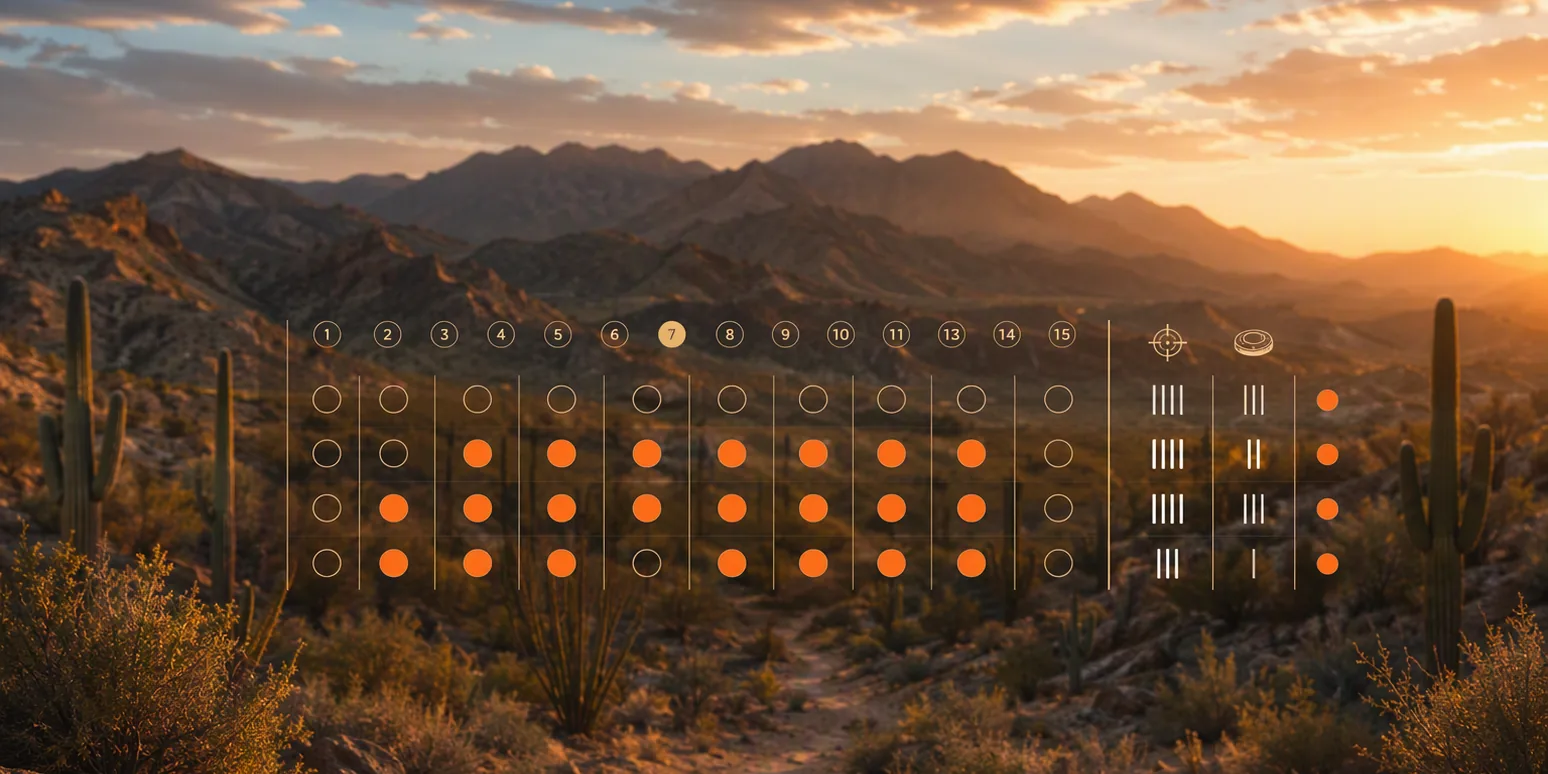
Every clay target round comes down to one number: how many you broke. The scorecard is how you get there — a simple grid that records each shot as a hit or a miss and adds them up at the end. But a trap card, a skeet card, and a sporting clays card don't look the same, because the three games aren't scored the same way. This guide walks through each discipline's scorecard, what the marks mean, and how a paper score sheet compares to scoring on your phone. For the short version of how the ClayTrack app scores each discipline, see how scoring works in ClayTrack.
New to the disciplines themselves? Start with sporting clays vs. skeet vs. trap for the differences, then come back here for how each one is scored.
What a clay shooting scorecard is
A clay shooting scorecard (also called a score sheet) is the record of a single round for one or more shooters. At its simplest it lists each target in the round and whether you hit it ("dead" or "killed") or missed it ("lost"). At the bottom you total the hits — that total, over the number of targets thrown, is your score. A perfect trap or skeet round is 25 straight; a perfect 100-target sporting clays round is 100.
Where the cards differ is structure. Trap and skeet have a fixed number of targets in a fixed order, so their cards are pre-printed grids. Sporting clays changes station to station and course to course, so its card is more flexible. Here's how each one is laid out.
Reading a trap scorecard
Trap
A flat 25-box grid — one shot per target, five targets at each of five stations. You mark each box hit or miss and total at the end.
The trap scorecard is the simplest of the three. Each shooter gets a row of 25 boxes, grouped into five sets of five — one set for each of the five stations you rotate through. You take a single shot at each target, mark the box, and move on. Because every target is a going-away bird and you only get one shot, there's nothing to track beyond hit or miss.
Most printed trap cards group the boxes in fives so you can see a per-station subtotal at a glance, then carry a running total to the right. Here's the shape of a single shooter's trap row:
| Station 1 | Station 2 | Station 3 | Station 4 | Station 5 | Total |
|---|---|---|---|---|---|
| ✓ ✓ ✗ ✓ ✓ | ✓ ✓ ✓ ✓ ✓ | ✓ ✗ ✓ ✓ ✓ | ✓ ✓ ✓ ✓ ✗ | ✓ ✓ ✓ ✓ ✓ | 22 / 25 |
Reading a skeet scorecard
Skeet
25 targets across eight stations, mixing high-house and low-house singles and doubles, plus the "option" target.
A skeet card also totals 25, but the layout follows the station-by-station shot sequence rather than even sets of five. Each box is labeled for where the target comes from — H for high house, L for low house — and doubles are marked as a pair. Stations 1, 2, 6, and 7 include doubles; stations 3, 4, 5, and 8 are singles.
The 25th shot is the option (sometimes called the "shoot-off" or "proviso") target. The tradition: you repeat the first target you miss. If you don't miss any of the first 24, you take the option as a low-house target at station 8. That quirk is why a skeet card always has one extra box hanging off the end of the sequence. For the whole round in order, see how skeet scoring works.
Reading a sporting clays scorecard
Sporting Clays
A station-by-station card with a variable number of targets per station. Totals aren't fixed until the round is done.
The sporting clays card is the most involved because the course is the most varied. Instead of fixed boxes, the card lists each station with room for that station's targets — and stations differ. One station might throw a single and a report pair (5 targets); the next a pair of true pairs (4 targets). You record hits and misses per station, then total across the whole course.
That's the catch with a sporting clays score sheet: until the round is complete, there's no fixed denominator to write down, because station counts vary by course. Your card shows your running hits, and the percentage only becomes meaningful at the end. Presentations you'll see on the card include:
- Single — one target, one shot.
- Report pair — the second target is launched on the report (sound) of your first shot.
- True pair — both targets launched simultaneously.
- Following pair — two targets from the same trap, one right after the other.
This is exactly the kind of bookkeeping that gets messy on paper — different target counts per station, pairs to track, and a total that nobody can verify until someone adds up the whole card. ClayTrack handles sporting clays station by station, lets you add each presentation as you shoot it, and keeps the hits-over-attempted total live the entire round.
Reading a 5-Stand scorecard
5-Stand is scored like a compact sporting clays round: 25 targets, five shooters working through five stations, each station offering a menu of five shots drawn from traps around the field. The card looks like a trap card — five sets of five — but the targets are varied like sporting clays. A perfect round is 25. If you understand the trap and sporting clays cards above, the 5-Stand card needs no extra explanation.
How to read the marks on a scorecard
There's no single universal notation, which trips up new shooters reading someone else's card. The conventions you'll run into:
- Hit ("dead" / "killed"): usually a slash (
/), anX, or a filled-in box. - Miss ("lost"): usually an
O, a dash (—), or a blank/circled box. - Doubles: two marks in one cell, read left target then right.
The only rule that truly matters is being consistent within a round so the totals are unambiguous. The downside of paper is real, though: smudged marks, "wait, was that a slash or an O?", and disputes over a total nobody can reconstruct. A digital scorecard removes the guesswork — every tap is recorded as an explicit hit or miss, and the math is never wrong.
Targets per round at a glance
| Discipline | Targets per round | Card layout | Perfect score |
|---|---|---|---|
| Trap | 25 | 5 stations × 5 boxes | 25 |
| Skeet | 25 | 8 stations + option, H/L labels | 25 |
| Sporting Clays | 50 or 100 | Station-by-station, variable | 50 / 100 |
| 5-Stand | 25 | 5 stations × 5 boxes | 25 |
Paper card or scoring app?
A printed scorecard is free, works without a signal, and has kept score at ranges for a century. If you want one, most ranges hand them out, and our free printable score sheets cover every discipline as print-ready PDFs. There's nothing wrong with paper for a casual round.
But paper has the same three problems every time: someone has to do the math, the card gets lost or rained on, and there's no history — last month's scores are in a glovebox somewhere. A digital scorecard fixes all three. With ClayTrack you tap each shot hit or miss, the total updates live, your whole squad scores together in real time across their own phones, and every round is saved to your profile so you can actually see whether you're improving. See it set up for each discipline: the digital trap scorecard and the sporting clays scoring app.
- Automatic totals — no adding up boxes between rounds.
- Live squad scoring — the whole squad plus guests, synced across devices.
- Built per discipline — a true 25-box trap card and a station-by-station sporting clays card, not one generic grid.
- Saved history & stats — personal bests, running accuracy, and full round history.
- Nothing to install — it runs in your browser on any phone, tablet, or laptop.

Trade the paper scorecard for a digital one
ClayTrack is a free clay shooting scorekeeper with dedicated digital scorecards for Trap and Sporting Clays — live squad scoring, automatic totals, and saved history. In your browser, no download needed.
Frequently asked questions
How do you keep score in trap shooting?
A trap round is 25 targets. Each shooter takes one shot at each target, firing five shots from each of five stations before rotating. On the scorecard you mark every target as a hit or a miss, total the hits at the bottom, and a perfect round is 25 out of 25 — often written 25/25 or called a "straight."
How does sporting clays scoring work?
Sporting clays is scored as the number of targets you break out of the total thrown — usually 50 or 100 per round. You shoot a series of stations, each presenting singles or pairs, and your scorecard records hits and misses station by station. There's no fixed denominator until the round is complete, because station counts vary by course.
What do the marks on a clay shooting scorecard mean?
Conventions vary, but a broken (hit) target is usually marked with a slash, an X, or a filled circle, and a missed ("lost") target with an O, a dash, or an open circle. What matters is being consistent within a round so the totals are clear. Digital scorecards remove the ambiguity by recording each shot explicitly as hit or miss.
How many targets are on a skeet scorecard?
A standard skeet round is 25 targets shot across eight stations, including singles and doubles from the high house and low house. The 25th target is the "option" — traditionally a repeat of the first target you miss, or a low-house shot at station eight if you go straight.
Is there a free clay shooting scorecard app?
Yes. ClayTrack is a free clay shooting scorekeeper that runs in any browser — no download required. It has dedicated digital scorecards for trap and sporting clays, lets your whole squad score together in real time, and keeps a running total automatically so you never have to add up a paper score sheet again.