
Every trap coach has watched a shooter drop two targets on the same post, week after week, and only noticed in the third month. The scores were there the whole time. They were on paper cards in a range bag.
Tracking your team's scores is not about more paperwork. It's about being able to say, with the numbers in front of you, who is improving, who is stuck, and what to work on this week. This guide covers what to write down, three ways to keep it, and how to use it. It also shows how a free clay shooting app for coaches does the adding up for you.
What to record for every shooter
A round of American Trap is 25 targets: 5 from each of 5 posts. The total out of 25 is the number everyone remembers, and by itself it tells you the least. Record these for each round:
- The date and the range. A shooter's home field and an away field are not the same test.
- The total, out of 25.
- The result on each post. A 21 with four misses spread across the field needs different coaching from a 21 with four misses on post 5.
- The game. Keep singles, handicap and doubles apart. For handicap, write down the yardage.
- One line of notes, when something stands out: wind, a new gun, a change of load, a rushed call.
If you only add one thing to what you record today, make it the result on each post. It's what turns a score into something you can coach.
Three ways to keep the scores
1. Paper score sheets
Paper is what every club already has, and it works with no signal and no batteries. The cost comes later. Someone has to keep the sheets, find last month's, and add up each shooter's average by hand. Results by post usually stay on the sheet and never get added up at all. If you stay on paper, keep each shooter's sheets together for the season, so one shooter's history sits in one place. You can print free scorecards here.
2. A spreadsheet
A spreadsheet adds up averages for you and can sort the team from highest to lowest. It's a real step up, and it's free. The weak point is the typing. Somebody copies every card into it after every practice, and the weeks when that person is busy are the weeks with no data. Most team spreadsheets also hold totals only, because typing 25 results for every shooter is more than anyone keeps up for a season.
3. An app each shooter scores in
With an app, the score is entered once, at the trap, target by target. Nobody types it up later, and the result on every post is kept because that's how the round was scored. What to check before you pick one: whether each shooter owns their own scores, whether you can see results by post and not just totals, whether it costs money per athlete, and whether you can get your data out as a spreadsheet.

Want the app to do the adding up?
ClayTrack is free for coaches and athletes. Each shooter scores on their phone, and you see every round.
What the numbers tell you
Look at the average, not the last round. One round tells you about one day. An average over the last five to ten rounds tells you about the shooter. To work one out, add up the targets hit and divide by the number of rounds: rounds of 21, 20 and 25 are 66 targets over 3 rounds, an average of 22.
Look at the trend. A shooter averaging 20 who was averaging 18 two months ago is doing better than a shooter who has sat at 21 all season. The trend tells you whether what you're working on is working.
Look at each post. Add up a shooter's hits on each post across several rounds. Many shooters have one post that costs them more than the others. That post is your next lesson.
Then look at the whole team. If half the team drops targets on the same post, that's not five separate problems. It's one drill for everyone.
Turn the scores into a practice plan
- Pick one thing per shooter. The weakest post, or the second target of a pair in doubles. One thing, not three.
- Set a goal they can reach in a few weeks. "Raise your average from 20 to 22" is a goal. "Shoot better" isn't.
- Check it against the next rounds, not against how practice felt.
- Tell them when it works. A shooter who hears "that 25 came from keeping your head down" knows what to repeat. Record the wins as carefully as the misses.
How it works in ClayTrack
ClayTrack is a free scoring app for trap, skeet and sporting clays, and coaching is part of it. Each shooter scores their rounds in their own account, on a phone at the trap. You send a coaching request, they accept, and from then on you can see their rounds. Nobody shares a password, and either of you can end coaching at any time.
- Your athletes on one screen: each one's rounds, average, best score and the date they last shot.
- Where each shooter misses: a station-by-station hit rate, built from the rounds they've already scored.
- Notes and goals: keep a note private or share it with the athlete, and set a goal for an average or a best score. Progress is worked out from their rounds, and a goal that's been reached shows as achieved.
- Teams: group athletes into a team and see the stations the team misses most.
- Your records: each athlete has a progress report, and you can export their rounds as a spreadsheet file (CSV).
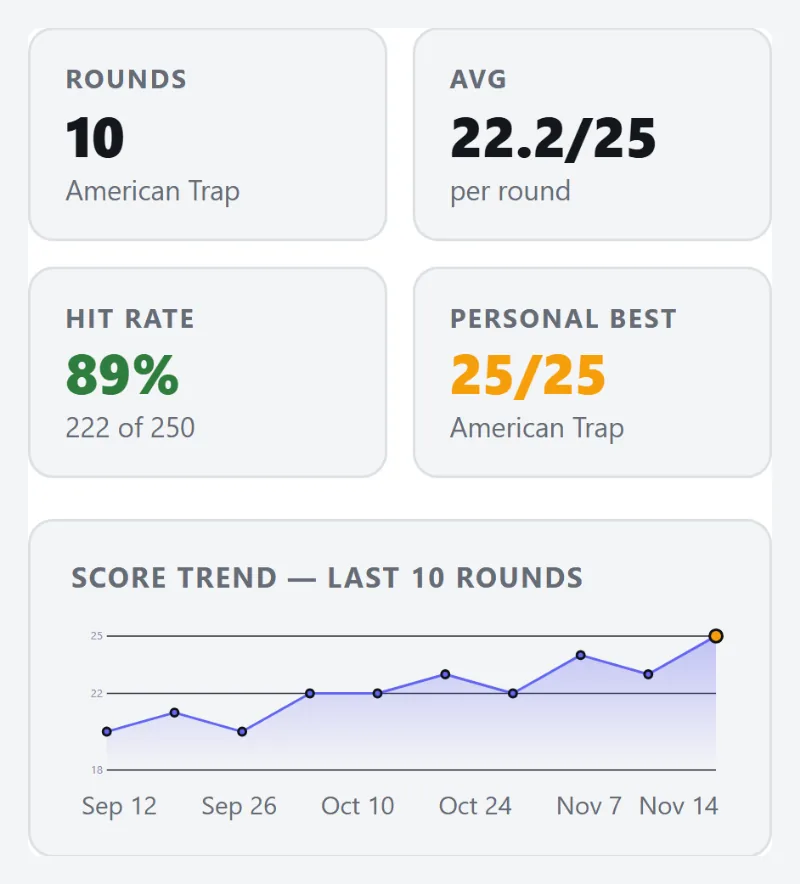
The picture at the top of this page is a team screen: five athletes ranked by average, and the stations the team misses most. Here is one of those athletes, with her coach's notes:
Start coaching on ClayTrack
Free for you and every athlete, with nothing to install. Create an account and send your first coaching request today.
Frequently asked questions
How do you work out a trap average?
Add up the targets hit and divide by the number of rounds. Rounds of 21, 20 and 25 are 66 targets over 3 rounds, an average of 22. Keep singles, handicap and doubles averages apart, because they are different games.
How many rounds do you need before an average means something?
One round tells you about one day. Look at an average over at least five to ten rounds, and at the trend across them, before changing anything in a shooter's setup.
Is there a free app to track a trap team's scores?
Yes. ClayTrack is free for the coach and every athlete. Each shooter keeps score in their own account and links with the coach, who then sees everyone's rounds, averages and results by station. It is built for adult athletes today.
Can a coach see a shooter's scores without sharing a login?
Yes. In ClayTrack the coach sends a coaching request and the shooter accepts it. The coach then sees that shooter's rounds and stats from the coach's own account, and either person can end coaching at any time.